How evaporative cooling works in an Australian house
A ducted evaporative cooler is a wet-pad weather machine: outdoor air, latent heat, a rooftop fan, and an open house that has to let the moisture leave.
Published 8 October 2024 · Updated 20 January 2026
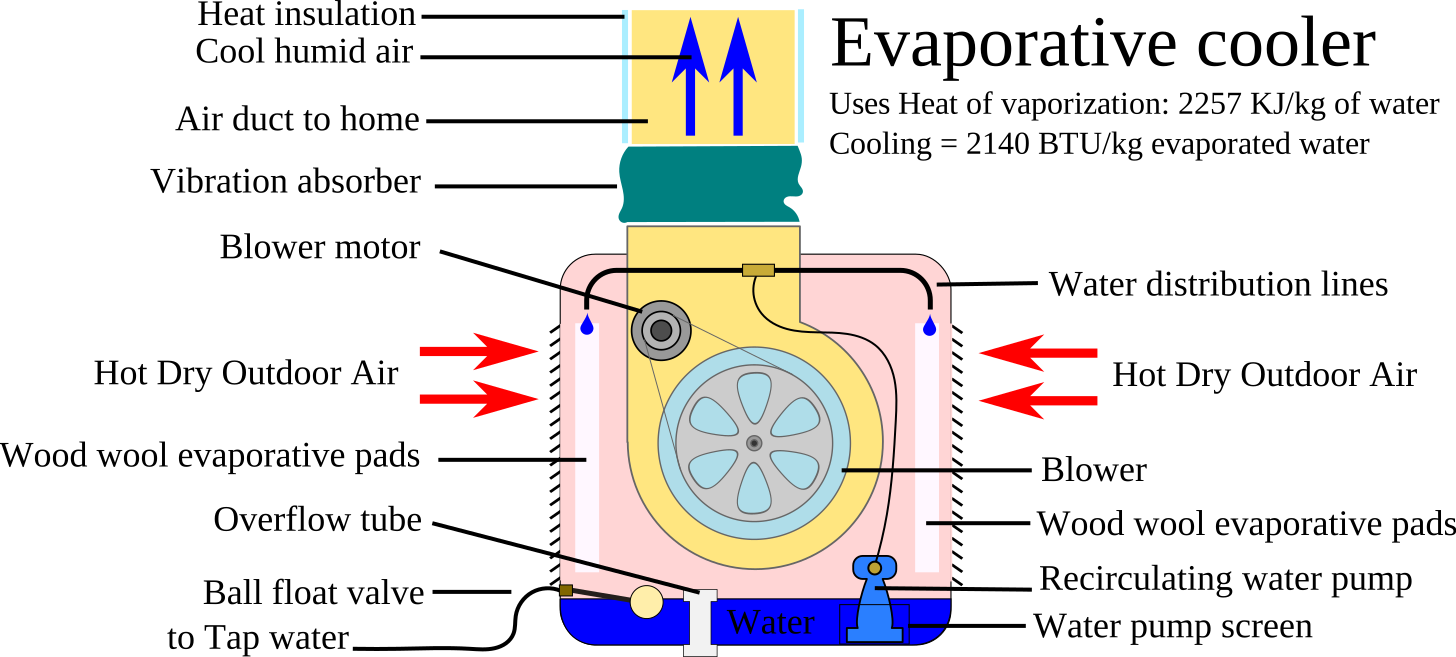
An evaporative cooler on an Australian roof is not a sealed box of cold. It is a small weather station: a sump of water, a set of wet pads, a fan that pulls outdoor air through those pads, and a house that has to breathe the result out again. Water changing phase from liquid to vapour takes heat with it. The air that did the evaporating leaves cooler than it arrived, and wetter.
That is the entire trick. Duct sizes, bleed-off hoses, winter covers and the argument about open windows are housekeeping around that change of phase.
What actually happens at the pad
Outdoor air is drawn through a wetted medium. Some of the water evaporates into the airstream. The energy required to turn liquid water into vapour is latent heat, and in this machine it comes mostly from the air. The air’s dry-bulb temperature falls. Its moisture content rises. The total heat in the airstream does not vanish. It has been rearranged.
If you have stood next to a dripping pad on a forty-degree afternoon in the wheatbelt, you already know the sensation. The air immediately downstream is cooler on the skin and thicker in the lungs. That is not refrigerated air. It is outdoor air that has paid for a phase change.
A pad that is dry is just a dusty obstruction. A pad that is flooded in one corner and bare in another is a short-circuit: some air gets a proper wetting, some air blasts through untreated, and the mixed supply temperature is worse than the brochure implied. Even wetting is the difference between a cooler and a noisy hole in the roof.
What a pad actually is
In the Australian rooftop trade the pad is usually a block of corrugated cellulose, stood on edge so water can run down the flutes while air moves across them. The corrugations stretch the wetted area into a small cabinet. Water is pumped from a sump to a distribution trough along the top of each pad. Gravity does the rest, or is supposed to.
Older units, and some portable machines, still use aspen-wood fibre — loose, cheap, and inclined to sag, slime and channel as it ages. Either material is doing the same job: hold a film of water in the path of a lot of air without washing the house.
A pad is not a High Efficiency Particulate Air filter. It will catch dust, insects and leaf litter because anything wet and corrugated will. That debris is a maintenance problem, not a purification feature. Scale from hard water glazes the flutes. Algae likes the dark and the wet. A collapsed pad lets air bypass the water entirely. None of this is solved by spraying perfume into the ducts.
Useful life depends on water quality, bleed-off, and whether anyone climbs on the roof before November. In hard-water districts many households change pads every one to three summers. Soft water and a well-set dump valve stretch that.

Latent heat, wet-bulb and dry-bulb
You need one distinction. Sensible heat is what a thermometer reports. Latent heat is energy tied up in the state of the water. When liquid becomes vapour, that energy is absorbed, so the thermometer on the supply grille falls even though you have added moisture to the air.
This is why a wet-bulb thermometer — a wick, a bit of water, a bit of airflow — reads lower than a dry-bulb thermometer in dry weather. The wick is a tiny evaporative cooler. The machine on the roof is the same instrument, scaled up and attached to ducts.
The dry-bulb is the number on the kitchen thermometer and the number the newsreader uses. The wet-bulb decides whether the cooler is a comfort machine or an expensive humidifier. The limit is not the colour of the cabinet. It is how much more water vapour the outdoor air can still hold.
On a hot, dry inland afternoon the two numbers sit a long way apart. Forty degrees dry-bulb with a wet-bulb in the low twenties is the climate this technology was built for: Perth, Adelaide, inland Victoria, the New South Wales slopes and west, the Queensland west around Longreach. Supply air can be pulled some way toward that wet-bulb. Pads are not perfect contactors, so the air will not quite get there, but the drop is large enough that a brick-veneer house with open windows becomes liveable.
On a humid coast the two numbers close up. Sydney in a muggy February, Brisbane, Cairns, Darwin in the wet: the wet-bulb is already high. You can still run the fan. Adding water on those days is how a lounge becomes a fernery.
Bureau of Meteorology readings that include humidity, dew point or wet-bulb are more useful than a maximum temperature shouted on its own. A cooler that felt miraculous at 2pm in January can feel pointless at 2pm in March if a moist change has come through. That is the atmosphere declining to cooperate.
The rooftop fan and the path of the air
A typical Australian ducted unit sits on the roof, often on a metal stand, and uses a centrifugal fan to pull outdoor air through the pads and push it into ducts in the ceiling space. The fan creates the airflow that makes evaporation happen, and it delivers that air to rooms. If it is fighting crushed flex duct, both jobs suffer.
The air is outdoor air. The hallway grille looks like any other air-conditioning vent, but it is not recirculating the room. It is a one-way flush. That is why the system can feel fresher than a reverse-cycle split on a clean, dry day, and why it is a poor idea when the outdoor air is smoke. The pads are wet, not magical. Bushfire smoke belongs outside.
Ducts leak. Insulation on ducts in a forty-degree roof space matters. A closed ceiling vent in a room you actually use is wasted fan work. The physics at the pad cannot rescue a delivery system that dumps half the cool air into the ceiling cavity.
Older units often have no useful thermostat. They run at the speed you set until you switch them off. A wall controller with four fan speeds and a pump switch is an honest interface. It is also why households learn, or fail to learn, the climate of their own street.
Why the moist air has to leave
Because the cooler is adding moisture, the house must exhaust air at roughly the rate the unit is supplying it. If you treat the place like a reverse-cycle box — windows shut, “keep the cold in” — humidity climbs, evaporation at the pad falls off, and people declare that evaporative cooling “doesn’t work”. What failed was the exhaust path.
Open windows and doors are part of the machine. The cooler is the intake. The windows are the relief. Which windows to open, and which to leave against a hot wind, is a separate practical problem. The principle is not negotiable.
A house that cannot dump air will also struggle to dump heat soaked into brickwork and slab. Evaporative cooling is a flushing strategy as much as a temperature strategy. That is uncomfortable news for anyone who wanted a sealed, silent bedroom. It is accurate news.
Water, power, and the honest running cost
The fan and the circulating pump are not large electrical loads by air-conditioning standards. Water is the other meter. NSW Planning has put typical consumption around 10 to 30 litres an hour depending on size and humidity. Water Corporation in Perth has said around 100 litres an hour can evaporate in hot weather, and has used a working picture of about 30,000 litres a year at six hours a day for fifty days. CHOICE, citing a 2009 study, reported 41 to 70 litres an hour in Hobart conditions and 67 to 116 in Adelaide. Those figures do not describe the same afternoon. They describe a machine that drinks.
Bleed-off — the dump that stops the sump turning into a mineral soup — often runs at 11 to 20 litres an hour on older setups. Newer systems can be closer to 3. Water Corporation’s field check is a bucket half full in thirty minutes, about 11 litres an hour. That water is not cooling the house. It is protecting the pads. Count both meters before you call the system cheap.
What the machine will not do
It will not dehumidify. It will not make a sealed nursery into a cool-room. It will not heat the house in July. It will not filter bushfire smoke. On humid days the honest move is fan-only, or off. In winter, cover the rooftop unit and close the ceiling vents so the hole in the roof stops being a hole.
In the right climate it will take a dry, punishing afternoon and make an open house liveable for the cost of a fan, a pump and a known volume of water. That is not a small thing in Perth, Adelaide, or a western slope town where the bitumen goes soft. It is also not reverse-cycle air conditioning in a different box, which is the comparison this journal keeps having to write out in full.
The pad, the latent heat, the wet-bulb, the fan and the open window are one system. Maintain the pads as if they were the coil, because they are. The rest of the year is just weather, and the machine only ever was a way of borrowing some of it.
Frequently asked
- How cold can an evaporative cooler actually get the air?
- Direct evaporative cooling can only take the supply air down toward the outdoor wet-bulb temperature, not toward a refrigerated coil setpoint. On a dry Perth or Adelaide afternoon that gap is large enough to live with. On a humid coastal day the wet-bulb sits close to the dry-bulb and the machine has almost nowhere to go.
- What is the pad in an evaporative cooler made of?
- Most Australian rooftop units use a rigid, corrugated cellulose pad that water is meant to wet evenly from the top. Older and cheaper machines sometimes use aspen-wood fibre. The pad is a wetted surface, not a filter you rinse forever; scale, dust and collapse all cut the contact area that actually cools the air.
- Why does the house feel clammy if the cooler is running?
- The unit is putting water vapour into the supply air. If that air cannot leave through open windows or doors, humidity rises, evaporation at the pad slows, and rooms feel wet rather than cool. Open an exhaust path before you turn the fan up.
More from How it works
How it works · 18 November 2024
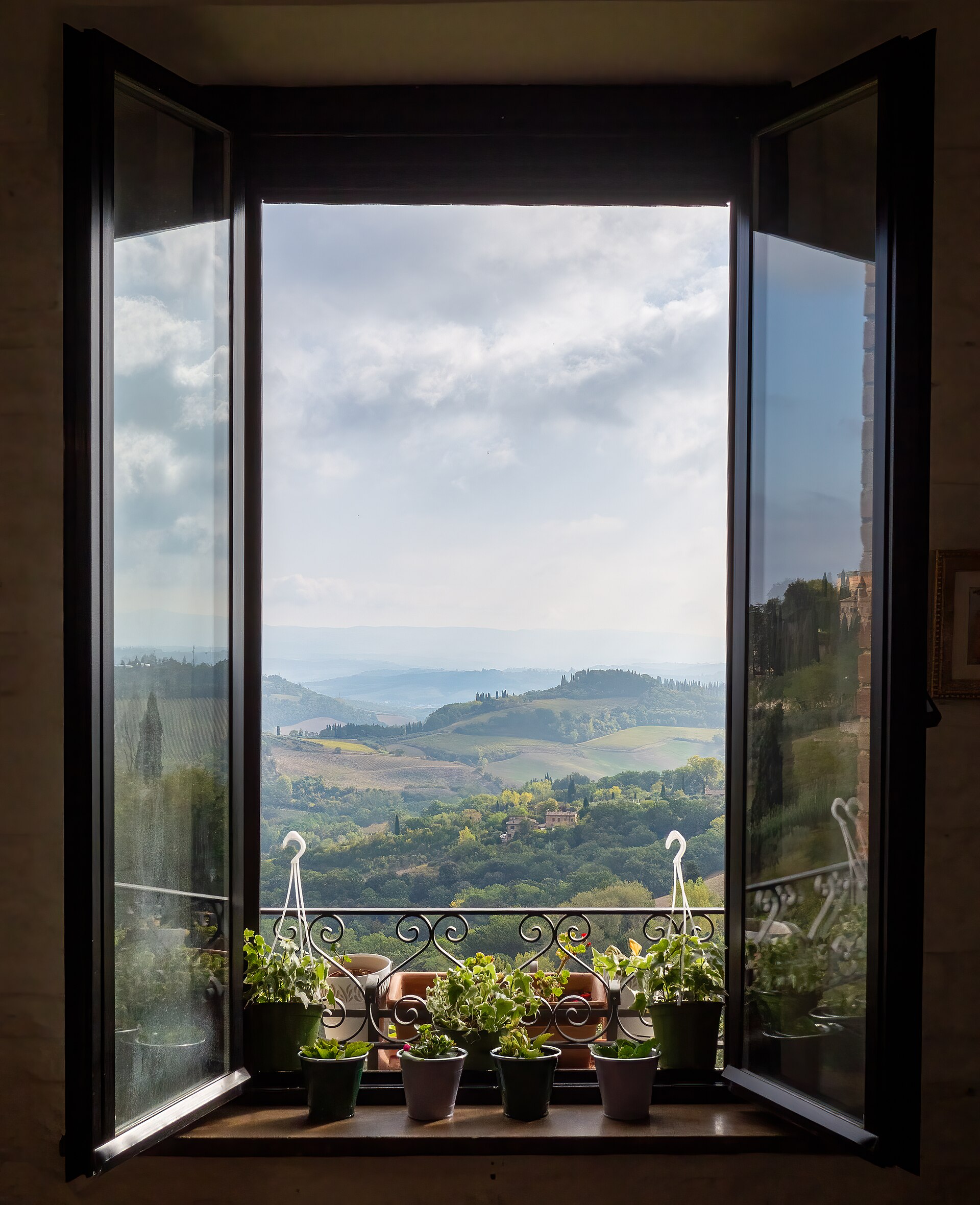
Why evaporative coolers need open windows
The cooler is an intake. Windows are the exhaust. Close them and you have built a humidifier with a loud fan and no way for the moisture to leave.
How it works · 5 November 2024
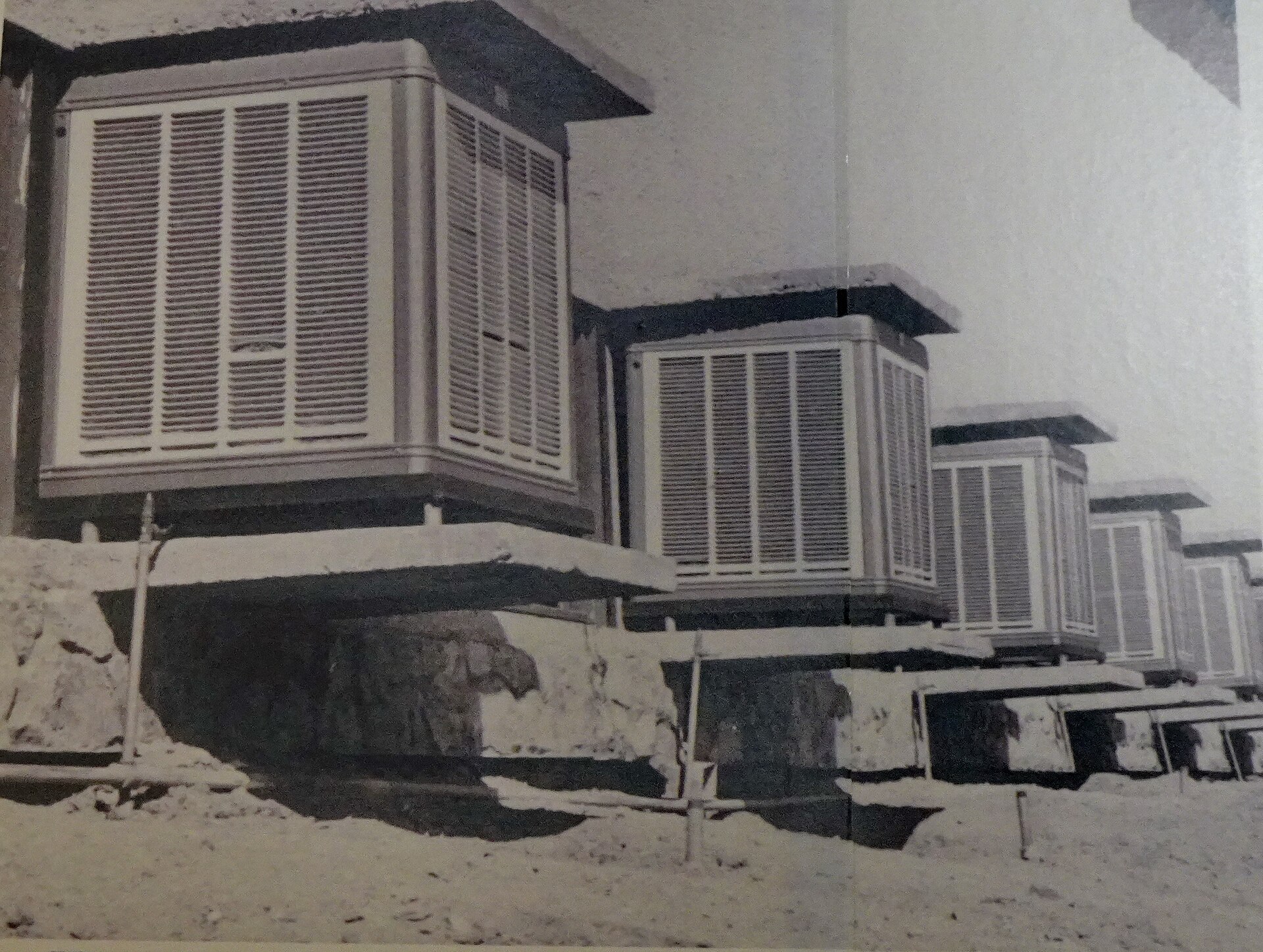
Direct versus indirect evaporative cooling
Direct systems wet the air you live in. Indirect and two-stage machines keep moisture out of the supply stream and chase a lower limit, at a price most Australian houses still will not pay.
How it works · 22 October 2024
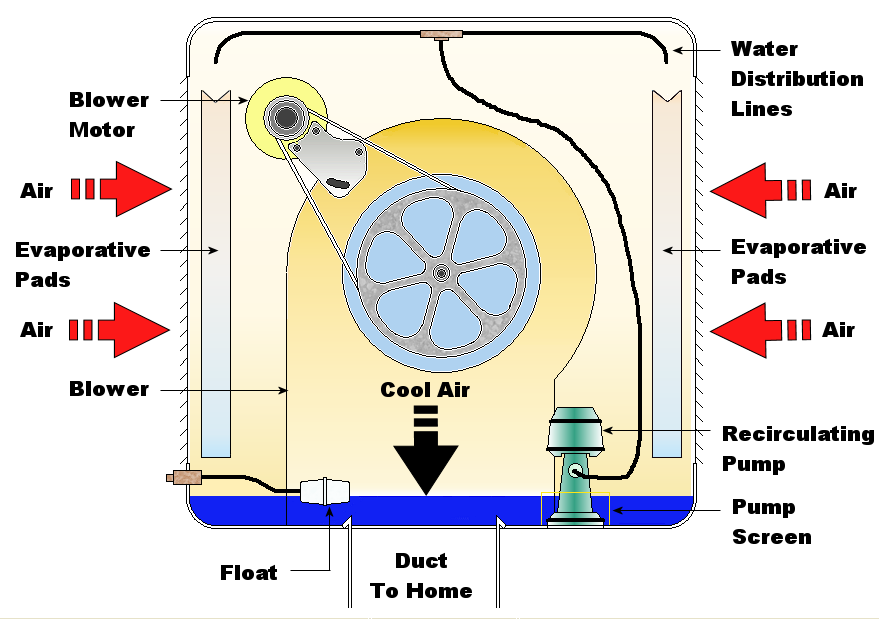
Evaporative coolers versus reverse-cycle air conditioning
One machine opens the house and adds moisture. The other seals it and wrings moisture out. Climate, smoke, water and winter decide which one you actually want.