Portable evaporative coolers: what they can and cannot do
A wheeled evaporative cooler can take the edge off a small, well-ventilated room in dry weather. It will not refrigerate a sealed lounge, and ice packs do not change the physics.
Published 14 December 2024
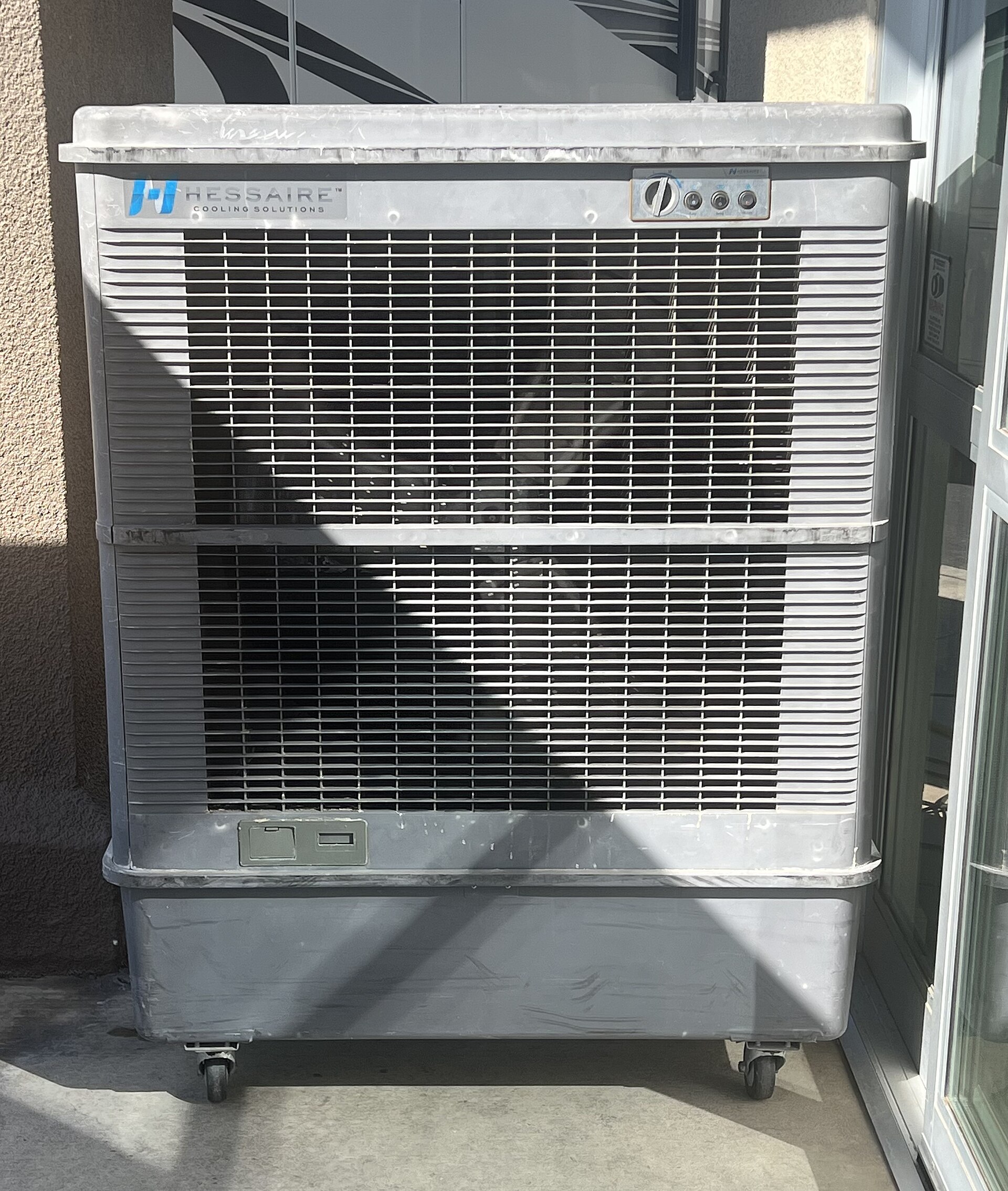
The portable evaporative cooler is an honest machine sold with dishonest expectations. In the box it is a fan, a small pump, a tank, and a pad or curtain of wet media on wheels. In the advertising it is a reverse-cycle split that you can park next to the sofa without drilling the wall. Those are not the same object.
Used as a small, local, dry-climate cooler in a room that can dump air, it can take the sting out of an afternoon. Used as a sealed-lounge miracle, it will humidify the curtains and leave you wondering whether the tank or the carpet is winning.
What the appliance actually is
Air is drawn through a wetted pad. Some water evaporates. The air leaves cooler and wetter. A fan throws that air into the room. You refill the tank when it empties, or you plumb a hose if the particular model allows it and you trust the float valve not to flood the skirting.
This is the same physics as the rooftop unit, shrunk until it fits through a doorway. The limits shrink with it. There is less pad area, less airflow, a tank instead of a mains-fed sump, and no duct system to share the result around a house. There is also, usually, no dedicated exhaust. That last point is where households go wrong.
A portable unit sitting in the middle of a closed room is trying to condition the same air it is humidifying, over and over, with no replacement stream of dry outdoor air. Direct evaporative cooling wants outdoor air in and moist air out. A box on casters cannot invent an outdoor-air intake just because the brochure shows a happy couple on a couch.
The 25-square-metre room, and why that number exists
As a working public figure, portable evaporative coolers are for rooms up to about 25 square metres. That is not a laboratory constant. It is a way of saying: this is a personal or small-room appliance. A west-facing lounge-dining with the kitchen attached is not a 25-square-metre room even if you only measure the rug.
Ceiling height, sun through glass, a tin roof with no insulation, and the number of people cooking pasta all eat capacity. So does humidity. A 20-square-metre sleep-out in dry Kalgoorlie weather with a window open is a plausible job. The same floor area in a Sydney February with the sliding door shut is a prank.
If the room is larger, you do not “just buy two portables” without thinking about water, noise and exhaust. Two humidifiers in a sealed space are not a system. They are a weather event.
Wall and window machines, which this journal treats separately, start to make sense when you need a hole to outdoors and a bit more capacity — roughly 30 to 50 square metres. Whole-house work is ducted. The portable’s job is the leftover room, the rental, the workshop corner, the verandah that still has a breeze.

Ice packs, frozen bottles, and other kitchen myths
Putting ice in the tank, or a frozen PET bottle, is a ritual with a short, real effect. You have added a lump of cold mass. While that mass melts, some extra sensible cooling happens in the water, and the air passing the pad can feel a little colder than wet-bulb-and-pad alone would give you. Then the ice is water at tank temperature, and you are back where you started, plus melt.
This does not change the governing limit. Direct evaporative cooling still heads toward the wet-bulb of the air at the pad. Ice does not wring moisture out of the room. It does not create an exhaust path. It does not make a humid day into a dry one. It is a way of spending freezer electricity to buy a brief psychological win.
Chilling the tank in a refrigerator overnight is the same idea at lower drama. Fine if you like the ritual. Do not build a purchase decision on it. If you needed refrigerated air, the tool is a refrigerated appliance.
Some units offer a “honeycomb” pad and talk as if media type abolished climate. Better contact helps you approach the wet-bulb more closely. It does not move the wet-bulb. A dry afternoon still wins. A humid one still loses.
Tanks, emptying, and the smell
A portable tank is a small pond. You will fill it, and you will empty it. If you do not empty it, you will grow a biology project. Tip the tank, wipe it, let the pad dry when you are not using the machine, and do not store it wet in a dark laundry for three months.
Where the water goes matters. Balcony drains, a garden, a sink — not the carpet, not a gap in the floorboards of a rental. Models that leak from poorly seated tanks are common enough that the first week of ownership should include a towel test on vinyl, not on the good rug.
Mains-fill kits exist. They remove the lifting of water and introduce the risk of a stuck valve. In a house you own, that can be a reasonable trade if you install it like plumbing. In a rented room, a hose to a laundry tap is how you explain a swollen skirting board to a landlord.
Bleed-off, in the rooftop sense, is rarely sophisticated on these appliances. Scale still happens. Vinegar-and-magic-internet-advice should not replace “do not leave mineral soup in a plastic tank in the sun”. Hard water will chalk the pad. Soft water and regular emptying will delay that.
Why they fail in sealed lounges
A sealed lounge is reverse-cycle territory. The room is a closed volume. A portable evaporative cooler adds vapour to that volume. Relative humidity rises. Sweat stops working. The thermometer may even fall a little at first, which encourages you to keep going. Then the air feels thick, the windows fog on the first cool change, and the unit is blamed for being “weak”.
Open a window or an external door so the moist air can leave, and place the cooler so it draws as much replacement air as the room allows. You are trying to create, in miniature, the exhaust path a ducted system needs. A doorway to a hotter hallway with no outdoor opening is not exhaust. A window on the windward side that blasts hot air straight at the pad may also be a poor plan; you want the machine to see outdoor air, but you do not want a forty-degree jet dominating the room.
If you cannot open anything — security, traffic, a high-rise hotel rule, smoke — do not run the pads. Fan-only moves air. Wet pads in a sealed room write humidity into the upholstery.
Smoke is a stop, as it is for any evaporative machine. You would not point a fan out the window into a bushfire plume and call it air conditioning. Do not do the indoor version.
Where a portable earns its keep
Dry-climate rentals where you cannot cut a wall. A home office with a window. A garage workshop with the roller door cracked. A verandah with shade. A country hall’s side room. A caravan annex, with all the usual caution about electrics and water on the floor.
It is also a way to test whether you even like evaporative cooling before you put a ducted unit on the roof — with the caveat that a portable in one room is not a fair preview of a whole-house flush. You can learn whether humidity bothers you. You cannot learn duct noise from a plastic box.
Power draw is usually modest: a fan and a pond pump. Water use is the tank you keep filling. That is not Perth Water Corporation’s 100 litres an hour, but it is also not zero, and on a day when the unit is left to run with the windows shut it is water spent on discomfort.
Compare it, if you must, with a portable refrigerated air conditioner. Those need a hose to dump heat out a window, they draw more power, they dehumidify, and they can actually cool a sealed room. Different machine, different compromises. The evaporative portable’s compromise is climate honesty: dry air and an opening, or do not bother.
If your lounge is sealed, your climate is humid, or you were hoping ice would negotiate with the atmosphere, spend the money elsewhere. If you have a small room, a dry afternoon, and a window you are willing to use as a flue, a portable evaporative cooler is a limited, useful, unromantic fan with a wet pad. That is the whole review.
Frequently asked
- Will a portable evaporative cooler cool a sealed living room?
- No. It is adding moisture to a closed volume. Humidity rises, evaporation slows, and you end up with a warm, wet room and a tank to empty. Open a window or door as an exhaust, or use a refrigerated appliance instead.
- Do ice packs or frozen bottles make portable evaporative coolers work better?
- They can make the first half-hour of air feel colder because you have dumped a small lump of extra sensible cooling into the tank. They do not turn the machine into a reverse-cycle unit, and once the ice is gone you are back to wet-bulb physics and a puddle.
- How big a room can a portable evaporative cooler handle?
- As a working household figure, rooms up to about 25 square metres, dry weather, with a real exhaust path. Beyond that you are asking a fan and a biscuit of wet media to impersonate a ducted system.
More from Systems

Systems · 17 February 2025
What to look for when buying an evaporative cooler
A useful quote names airflow, water management, pad type and who will service the roof. Brand names describe the Australian market; they are not a ranking.

Systems · 3 February 2025
How to size an evaporative cooler for an Australian house
Floor area is a starting guess, not a size. Airflow, ceiling height, insulation and leaky ducts decide whether a rooftop unit can actually cool the rooms you live in.
Systems · 20 January 2025
Commercial evaporative cooling for sheds, warehouses and workplaces
High-volume sheds and warehouses can still be cooled with wet pads if the air can leave, the pads are serviced, and heat is treated as an OH&S problem rather than a comfort extra.